
Universal API
Connect Odoo to your APIs
without development
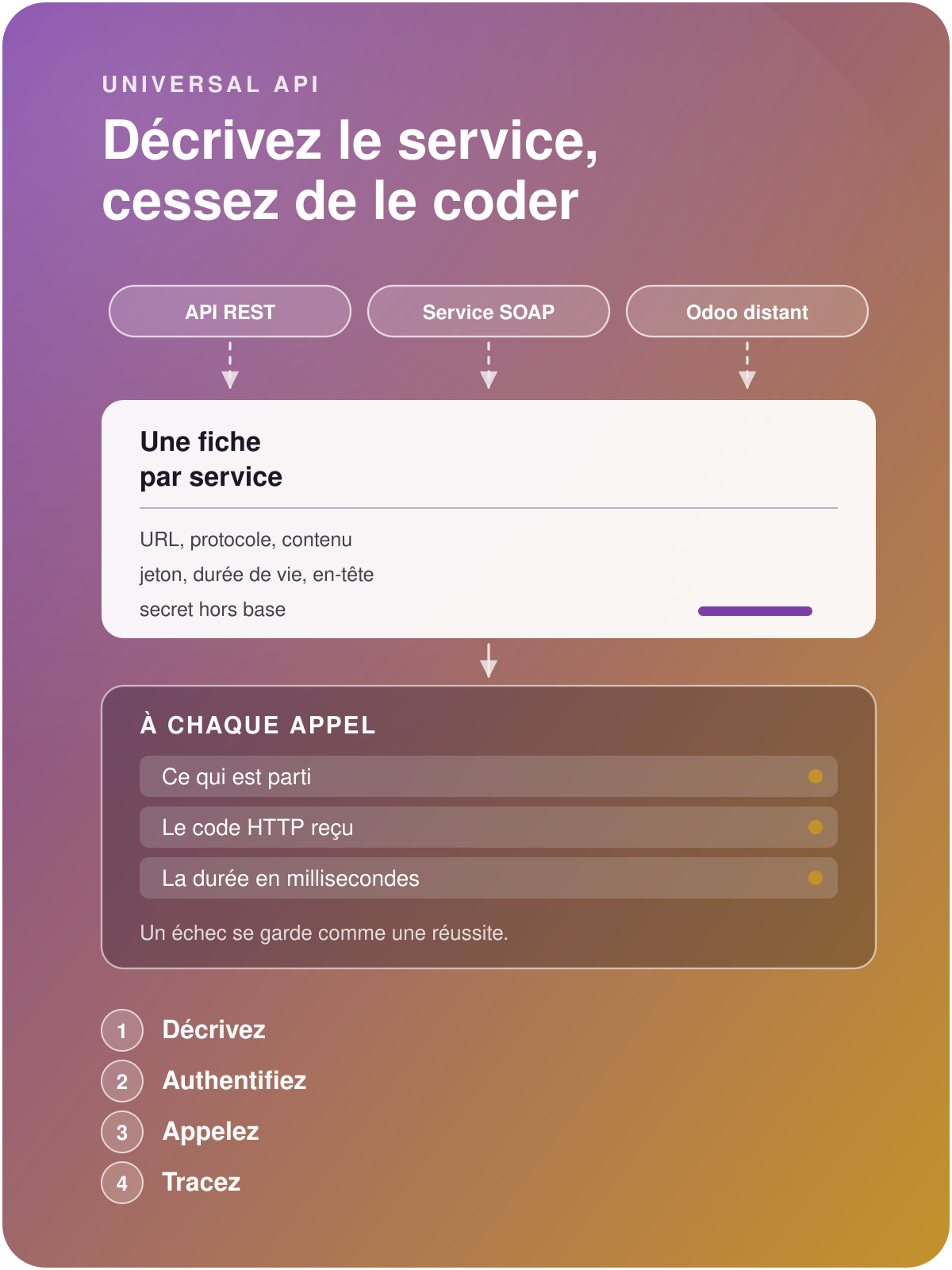
The URL, the protocol, the authentication mode, the endpoints and the token lifetime are configured for each API, whether open or private.
Connect an API service without writing a line of code
Without Universal API
Each service requires its own module, written for it alone, which has to hold the path of every resource, code the reading of every request and every response, and write the mappings to Odoo objects.
A single flow takes several weeks of development, which quickly adds up to several tens of thousands of euros.
Maintaining each connector is costly, since the slightest change requires development, not to mention the Odoo version upgrade.
With Universal API
Each API is configured from its technical documentation, and can be tested and used directly in Odoo without any development.
Setting up a flow takes hours rather than weeks: its cost is divided by five on average.
Your flow evolves: the configuration is adjusted, without delay.
At each Odoo version upgrade, no effort is needed: Universal API is available in every new version, and any update would be automated and transparent for you.
Stop writing a module per supplier, describe a record

Re-read the connection six months later
Six months later, you open the record and see how the service is reached: URL, protocol, authentication, environments. The record says it all, and your teams can re-read it.

Forget expired tokens
Declared lifetime, automatic renewal before expiry, history kept if you ask for it: the case that most often interrupts an exchange is handled once and for all.

Diagnose an incident from Odoo
The HTTP code, the duration and the full response are kept for every call, successful or failed. The question "what was sent?" gets its answer from Odoo.

Describe the service once, use it everywhere
URL, protocol, content type, environment and authentication mode fit on one record. It is the same for a free public service and for a supplier's API that requires a token renewed every hour.
REST, RPC, SOAP or JSON-RPC: SOAP goes through its WSDL, and JSON-RPC talks to another Odoo.
JSON or XML, down to partial update formats.
Authentication header of your choice, secret kept out of the database: the token can be read from the server environment
Four environments on the same description: production, test, pre-production, development.
SSL verification can be switched off, for an internal service with a home-made certificate.
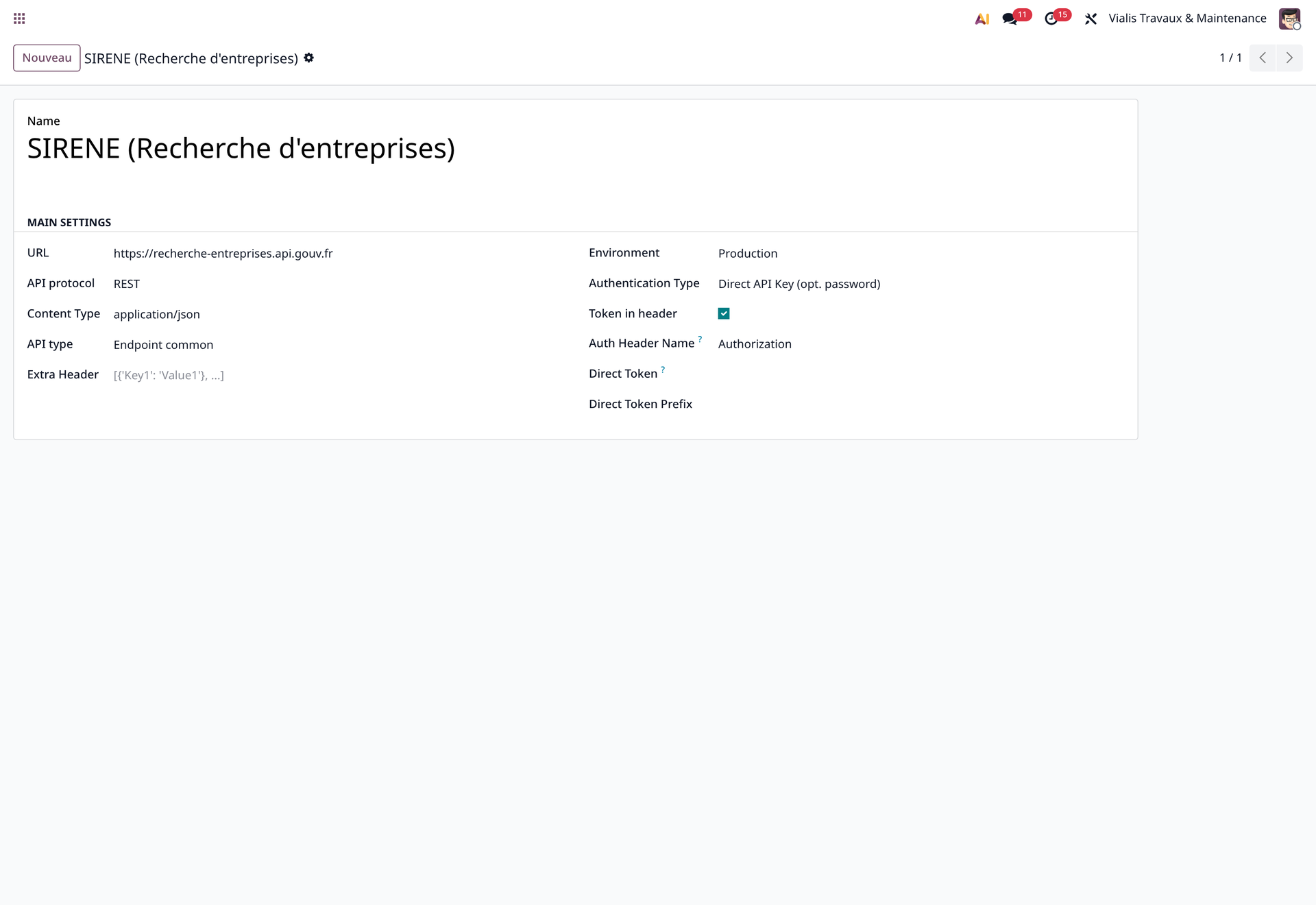
The French State's "Company search" service, described on demo19.
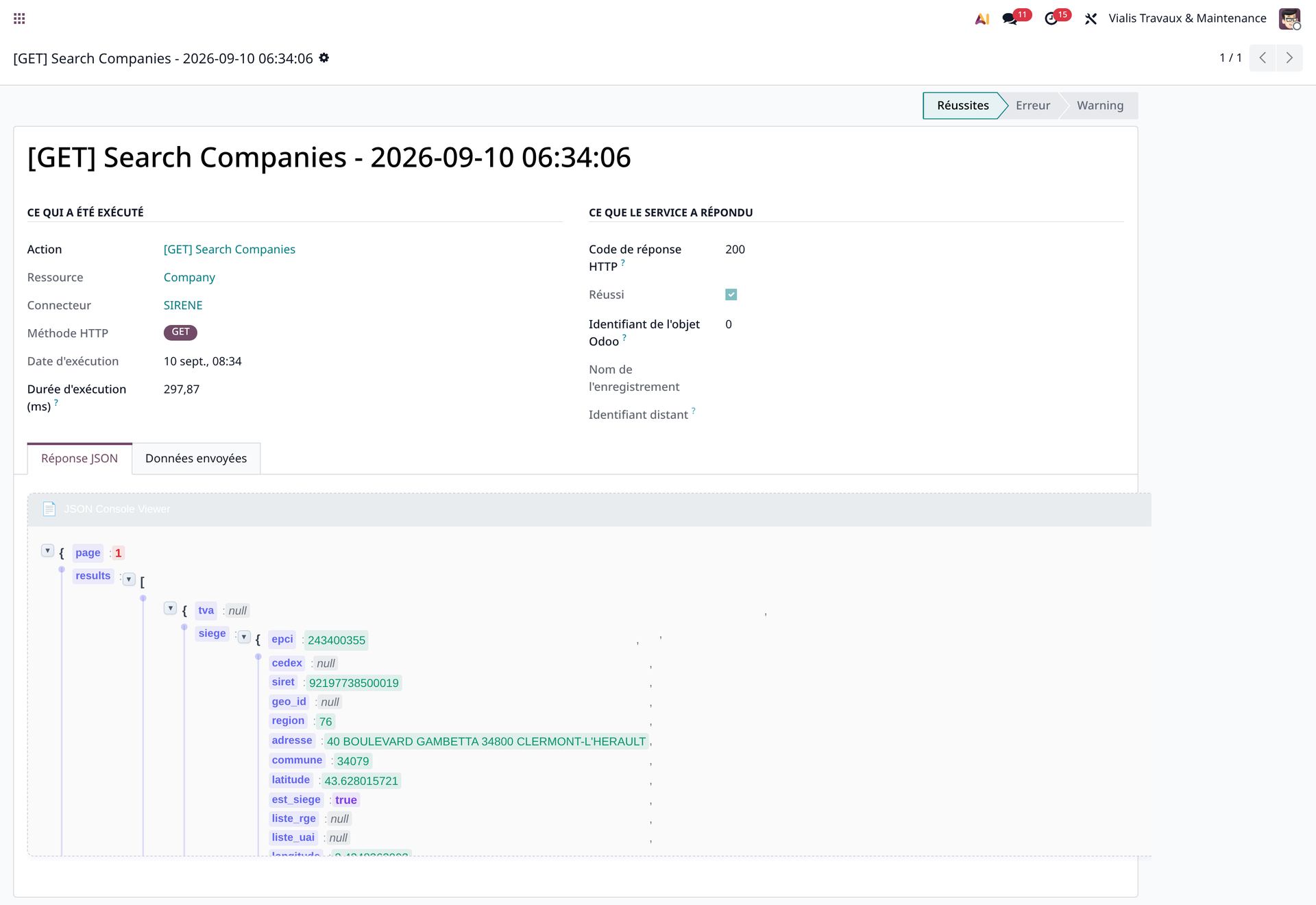
A real call: HTTP 200 in 297 ms, and its response unfolded.

Find what was sent, measure what came back
What was sent, what came back, the HTTP code and the duration: the response is kept as is and unfolds in a JSON inspection console, inside Odoo.
Duration in milliseconds: slowness can be measured. The demonstration call answers in 297 ms.
Token history, if you ask to keep it.
Failures are kept just like successes.
The most frequently called APIs

Complete a customer record, spare yourself typing the company number
The French State's SIRENE "Company search" API is free and openly accessible. A search by name, VAT number or SIREN returns the address, the SIRET and the activity, directly in the contact record. Included in your hosting.
Selected fields: you decide which fields come back.
The company register and the public ship register come already described.

Query catalogues and availability
A supplier that exposes an API imposes its authentication mode and its call limits. Both are declared on the record.
The number of results per page is a parameter of the record.
Every call keeps its trace, which makes a claim verifiable.
Create your products directly, update your sales quotations directly
Communicate with your logistics providers (receipts, delivery notes).

Connect your in-house software as it is
In-house software, a data warehouse, a business application: as soon as it exposes an API, it is described like the others.
Typed entry points: authentication, token check and object, each with its own path.
The call is run by Universal Connector, on demand or by a scheduled task.
Before connecting your APIs
No. Each API is defined individually: URL, protocol, authentication, environments. That is the very principle of Universal API.
Yes, whenever the service allows it. The demonstration relies on the French State's public "Company search" API, free and without a key.
No: it describes the service. The call is run by Universal Connector, and the response is mapped by Universal Data Tool.
Proven, at customers in production: data migrations, regular file exchanges, API calls to public and private services.